
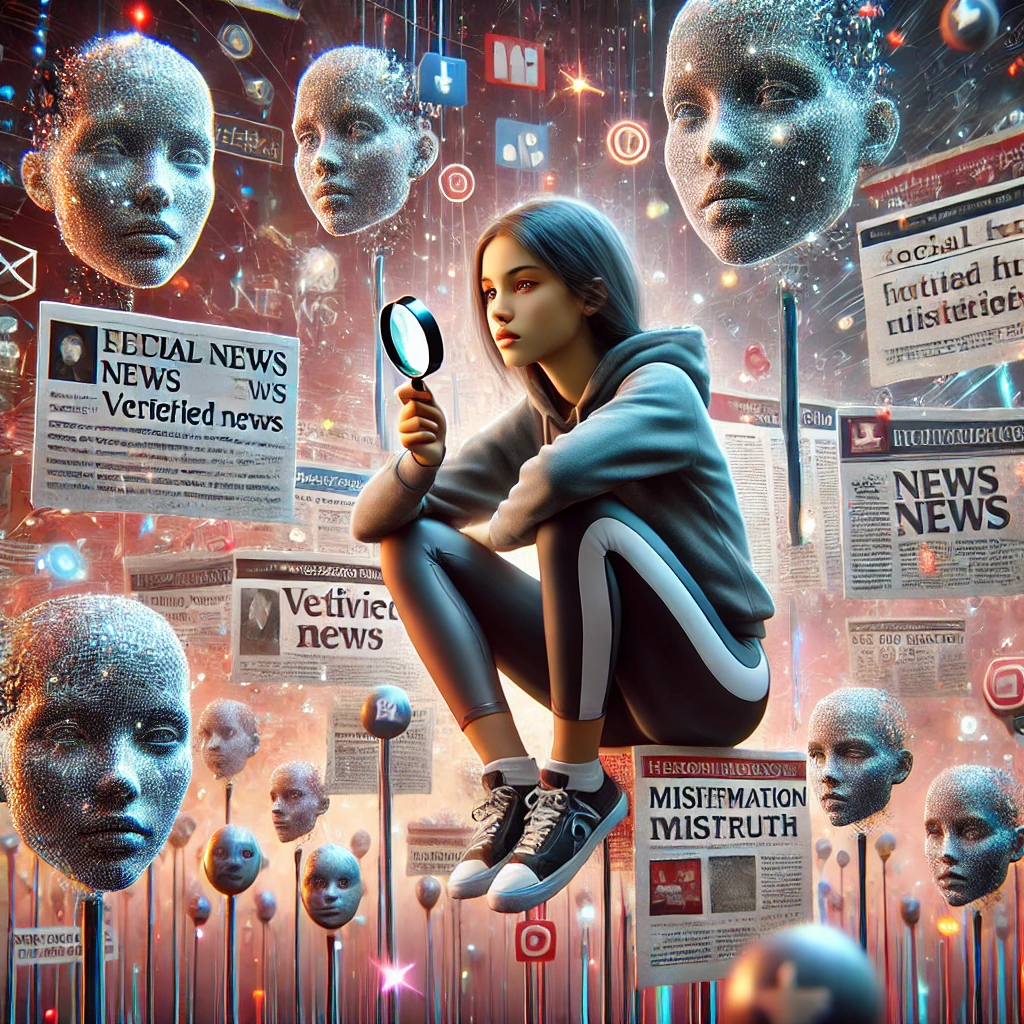
In the last few weeks, the girls in Be the Voice of Girls have explored the Art of the Interview—uncovering what it takes to ask compelling questions, listen actively, and share stories that matter. This past session, led by journalist Eriech Tapia, brought everything full circle as we dove into the role of social media in shaping public narratives, the challenge of separating fact from fiction, and the surprising ways artificial intelligence can blur the lines between reality and illusion.
As the discussion began, the girls reflected on how much they had learned over the past sessions—how asking the right questions could shape an interview, how to distinguish between open-ended and closed-ended questions, and how storytelling could be used as a powerful tool. Then, Eriech steered us into the world of social media: What exactly is social media, and how does it influence the way we consume and share information? As expected, Instagram, TikTok, and X (formerly Twitter) topped the list, but there were some surprises—YouTube, Reddit, and even book-sharing platforms like Goodreads were discussed as tools that blur the line between entertainment, news, and community interaction.
Then came a deeper dive: How do we recognize good journalism in a world overflowing with information? The girls were quick to recall the lessons of previous weeks—using the Five W’s (Who, What, Where, When, Why) and How to frame a solid story, distinguishing between open-ended and closed-ended questions, and, most importantly, understanding the difference between truth and fact. The sky may be blue, Eriech explained, but a fuller truth acknowledges the clouds, airplanes, and everything else that exists alongside that single fact. The same applies to journalism—context matters.
Putting Journalism to the Test: A Social Media Scavenger Hunt
To put their skills into action, the girls embarked on a social media scavenger hunt. Their task? Find a news story on their feed, identify its source, and determine whether they personally follow that news outlet or if the algorithm had simply placed it in their path. The results were fascinating. One girl found a BBC article—after admitting that her usual feed was mostly filled with cat videos. Another came across a major news story about a proposed law in Turkey, but wasn’t sure whether the source was credible. It was a powerful moment of realization: just because something appears in your feed, that doesn’t mean it’s the whole story.
From there, Eriech took the discussion a step further—introducing the girls to the unsettling world of deepfakes and AI-generated images. They were shown photos of people who looked entirely real… except none of them had ever existed. “Which of these faces is fake?” Eriech asked. A few confident guesses were thrown out—only for him to reveal that all of them were AI-generated. The gasps and nervous laughter were immediate. The next challenge? Identifying edited images in real news stories. Were the protesters in that photo really there? Was the flood as severe as the viral image claimed? In a world where misinformation spreads in seconds, these skills aren’t just important for journalists—they’re critical for anyone who consumes news.
Parting Words: Your Voice Matters
As the session wrapped up, Eriech left the girls with some final words of wisdom:
- Think before you share. One click can spread misinformation—always check the facts.
- Never stop asking questions. Curiosity is the key to uncovering truth.
- Your voice matters. Whether as a journalist, an artist, a student, or a future leader—what you say and how you say it can make a real difference.
With that, the Art of the Interview series came to a close—but the skills the girls have gained will stay with them far beyond this program. They leave not just as better interviewers, but as sharper thinkers, more confident speakers, and, most importantly, as young women ready to use their voices to tell stories that matter.
